
By Dr. Daniel Shafran, MD, FRCPC · Updated October 2026
Toenail fungus (onychomycosis) is one of the most common things patients ask me about. It's stubborn, it comes back, and it's more than cosmetic — especially if you have diabetes, where thick, infected nails can lead to skin breakdown and ulcers. Here's what the research shows about the three main treatments, in plain language.
First, how to read the numbers
Treatment studies measure success in different ways, and the differences matter. A treatment can look much better or worse depending on which result is reported.
Keep these in mind as you read the comparison below — the numbers aren't measuring the same thing.
Terbinafine (oral)
Terbinafine is a pill taken once a day for 12 weeks. It has the most research of any treatment for toenail fungus.
- How well it works: In a review of 8 randomized trials (over 1,000 people), about half of nails were clinically cured with terbinafine, compared with 6% on placebo, and fungus cleared in about 3 in 5.1 In a large head-to-head trial in the BMJ, fungus cleared in 76% of people after 12 weeks of terbinafine — about twice the rate seen with itraconazole, another pill.2
- Drawbacks: It's a whole-body medication. Rare but serious liver injury has been reported, so your prescriber may check your liver before or during treatment. It can also interact with some medications, and taste changes can occur.1,4
- Best for: People with several infected nails, or moderate to severe disease, who can safely take it.
Jublia (efinaconazole, topical)
Jublia is a liquid brushed onto the nail every day for 48 weeks.
- How well it works: In two large randomized trials (over 1,600 people) published in the Journal of the American Academy of Dermatology, fungus cleared in 53–55% of people, but complete cure occurred in 15–18% — about 1 in 6.3
- Drawbacks: It's slow, needs daily use for almost a year, and cures fewer nails than terbinafine. Side effects are mostly mild skin irritation where it's applied.
- Best for: Mild to moderate fungus, or people who shouldn't take terbinafine.
ToeFX (photodynamic light therapy)
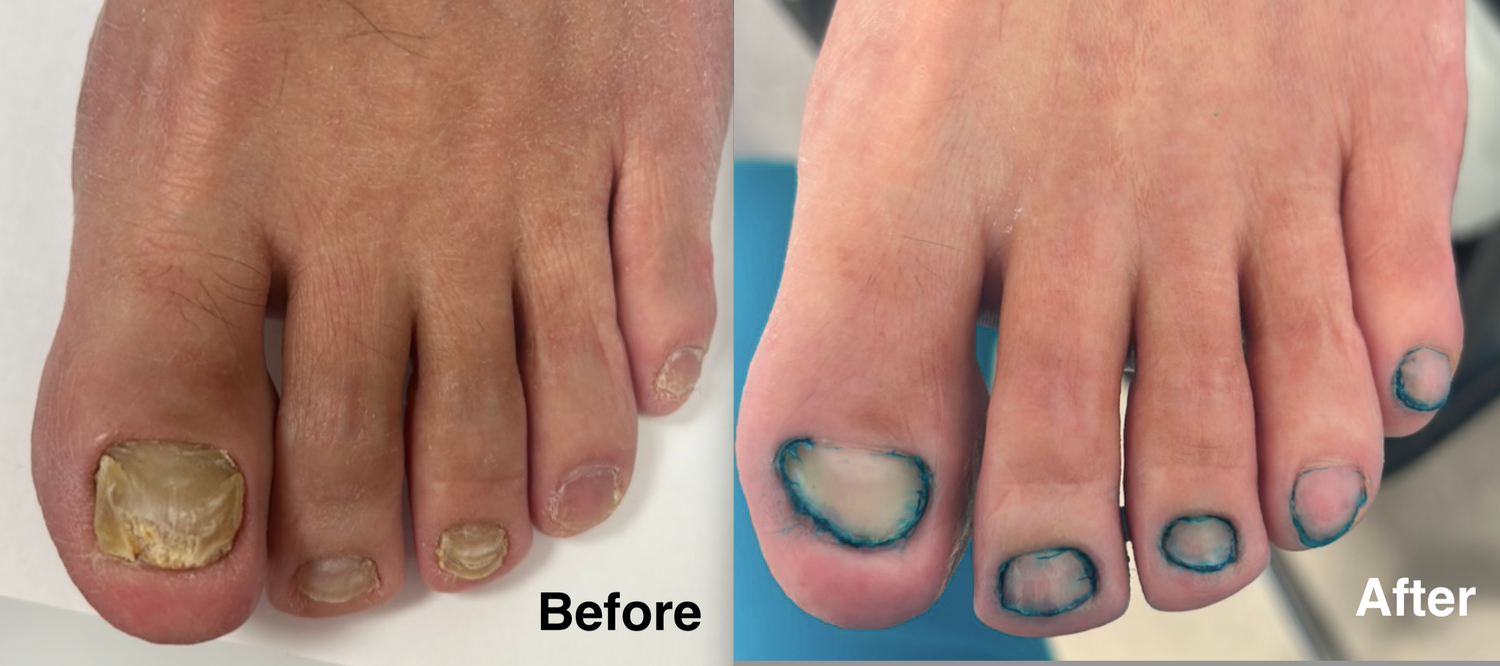
ToeFX is a Health Canada–approved light therapy. A light-activated serum is applied to the nail, then a specialized light passes through the nail and disrupts the fungus underneath. Sessions take about 30 minutes, every 2 weeks, for about 6 months.
- How well it works: In the 6-month study used for its Health Canada approval, 76% of treated toes were at least half clear, and 97% of patients responded to treatment.5 These are encouraging results. The study was small (20 patients), run by the manufacturer and didn't include a comparison group, and it measured nail clearing rather than complete cure — so it isn't directly comparable with the drug trials above. A larger randomized ToeFX trial has been completed, and we're watching for its published results.6
- Drawbacks: It takes regular clinic visits, isn't covered by Alberta Health, and most patients continue occasional maintenance sessions to keep fungus from coming back.
- Best for: People who can't or don't want to take medication — including many older adults and people with diabetes who already take several medications — or as an add-on to a prescription.
Side by side
| ToeFX light therapy | Jublia (topical) | Terbinafine (oral) | |
|---|---|---|---|
| How it's used | 30-minute clinic session every 2 weeks | Applied to the nail every day | A pill every day |
| Typical course | About 6 months | 48 weeks | 12 weeks (the nail keeps growing out after) |
| Side effects | None reported — a temporary blue tint | Skin irritation where applied | Uncommon but can affect the liver; drug interactions |
| Prescription needed? | No | Yes | Yes |
| Reported results | 76% of toes at least half clear at 6 months5 | Complete cure in 15–18%; fungus cleared in 53–55%3 | Clinical cure in about half; fungus cleared in about 3 in 51 |
| Quality of evidence | Small manufacturer study, no comparison group; larger trial completed | Two large randomized trials | Many randomized trials |
Why combining treatments helps
Fungus lives in and under a thick nail, where medication struggles to reach. That's why we approach it from several angles at once:
- Thinning the nail during a medical pedicure lowers the amount of fungus and helps treatment reach the nail bed.
- ToeFX targets the fungus directly, without medication.
- A prescription — terbinafine or Jublia — can be added when it's safe and appropriate. Our nurses can't prescribe, but we send specific recommendations for you to bring to your doctor.
Keeping it from coming back
Toenail fungus often returns, even after successful treatment. A few habits help: keep feet dry, change socks daily, wear sandals in shared showers and pool areas, don't share nail clippers, and treat athlete's foot early. Many ToeFX patients also continue a maintenance session every 6 to 8 weeks.
When to see a doctor
Not every thick or discoloured nail is fungus — psoriasis, injury and other conditions can look similar. See your doctor if:
- The skin around the nail is red, warm, swollen or draining
- You have diabetes and notice any break in the skin
- A dark streak appears in the nail that you can't explain
Open wounds below the knee need wound care, which requires a referral from your doctor or nurse practitioner.
The bottom line
Terbinafine has the strongest evidence, but it isn't right for everyone. ToeFX offers a medication-free option with promising results, and it can be combined with a prescription. A short consultation can help you choose.
Have your Alberta Health card ready — or call (780) 409-5673 to book.
Common questions
What is the most effective treatment for toenail fungus?
Oral terbinafine has the strongest research evidence, with clinical cure in about half of nails in randomized trials. It isn't right for everyone, though, and combining treatments — nail thinning, ToeFX and a prescription — often gives the best chance of a clear nail.
Is ToeFX better than terbinafine?
They haven't been compared head to head. ToeFX's early results are encouraging and it avoids medication side effects, but terbinafine's results come from larger, stricter trials. They can also be used together.
Does Jublia work?
Yes, but slowly. In two large trials, Jublia cleared fungus in about half of people after 48 weeks of daily use, with a complete cure in about 1 in 6.
Is toenail fungus dangerous if I have diabetes?
It can be. Thick, infected nails can press on the skin and lead to breakdown, infection and ulcers. Treating fungus and keeping nails thin is part of good diabetic foot care.
Do I need a referral for ToeFX?
No. You can book a ToeFX consultation online — have your Alberta Health card ready — or call (780) 409-5673.
References
- Kreijkamp-Kaspers S, Hawke K, Guo L, et al. Oral antifungal medication for toenail onychomycosis. Cochrane Database of Systematic Reviews. 2017;(7):CD010031.
- Evans EGV, Sigurgeirsson B. Double blind, randomised study of continuous terbinafine compared with intermittent itraconazole in treatment of toenail onychomycosis. BMJ. 1999;318:1031–1035.
- Elewski BE, Rich P, Pollak R, et al. Efinaconazole 10% solution in the treatment of toenail onychomycosis: two phase III multicenter, randomized, double-blind studies. Journal of the American Academy of Dermatology. 2013;68:600–608.
- Terbinafine product monograph. Health Canada Drug Product Database.
- ToeFX Inc. Clinical study summary: 6-month trial of photodisinfection for toenail onychomycosis (20 patients, 29 toes), used for Health Canada approval, 2020.
- ToeFX. Light therapy for onychomycosis study. ClinicalTrials.gov identifier NCT05139888.