
Foot ulcers are one of the most serious complications of diabetes, and one of the most preventable. In my practice, the patients who do best are the ones who come in early — when a wound is small, clean, and quick to heal. This guide covers what to watch for, what to do, and how to keep ulcers from coming back.
Why diabetic foot ulcers are serious
Up to one in three people with diabetes will develop a foot ulcer in their lifetime. They aren't just a skin problem. About 30% of people die within five years of a diabetic foot ulcer — and about 70% after a major amputation — a rate comparable to many cancers. In Canada, hospital stays for foot ulcers cost more than admissions for heart failure or pneumonia.
The good news: most amputations start with an ulcer, and most ulcers can be caught early or prevented altogether.
What causes them?
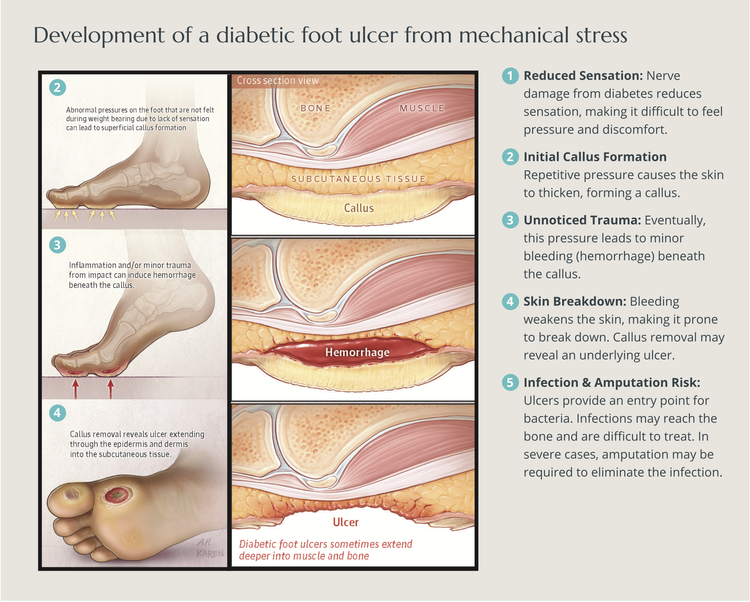
The main cause is neuropathy — nerve damage from diabetes. It works in three ways:
- Loss of feeling. You don't notice a blister, a stone in your shoe, or a cut from trimming your nails.
- Changes in foot shape. Weak foot muscles lead to hammertoes and pressure points that build up thick calluses.
- Dry, cracked skin. The nerves that control sweating stop working, so skin splits more easily.
Repeated pressure on a callus eventually breaks the skin underneath. Poor circulation then slows healing. Other things make it harder to catch problems early — trouble reaching or seeing your feet, vision changes, and shoes that don't fit well.
Warning signs to look for
- An open sore or blisterEven a small one — and even if it doesn't hurt.
- Drainage on your socksA wet or stained spot often shows up before you see the wound.
- A dark spot in a callusBleeding under a callus often means a wound is forming beneath it.
- Redness, warmth, or swellingAround a sore, or anywhere on the foot.
- A hot, swollen footEspecially with little pain — this can be Charcot foot, which needs urgent care.
- A bad smellA sign of infection.
Go to the emergency department if
- Redness or swelling is spreading
- You have a fever, chills, or feel unwell
- A toe or area of skin is turning dark or black
- Your foot is suddenly cold, pale, or very painful
- You have new pain in a foot that's usually numb
These can mean a serious infection or blocked blood flow. Don't wait for a clinic appointment.
What to do if you find an ulcer
- Take the pressure off. Stay off that foot as much as you can. For a wound on the bottom of the foot, a walker, crutches, or a knee scooter helps.
- Cover it. Use a clean, dry dressing. Don't soak your foot, use heating pads, or try corn removers.
- Check your shoes. Wounds on the top or side of the foot are often caused by shoes that rub. Stop wearing that pair.
- See your doctor within a day or two. Ask for a referral to a wound care clinic. Ulcers heal faster when they're treated early by a dedicated team.
How we treat foot ulcers
Our wound care clinic is built for exactly this. At every visit you're seen by a physician and a nurse together. Treatment focuses on five things:
- Offloading — taking pressure off the wound. We can provide temporary offloading footwear, and may prescribe therapeutic footwear such as orthotics or custom shoes.
- Debridement — removing callus and dead tissue so the wound can heal.
- Dressings — chosen for your wound, with orders sent to home care when needed.
- Infection — checking for it and treating it.
- Blood flow — checking circulation, with referral to vascular surgery if it's poor.
We also use compression wraps for leg wounds, and refer to surgery when needed. Your family doctor gets a consult letter after each visit, uploaded to Netcare.
Preventing ulcers — and keeping them from coming back
Once you've had an ulcer, we think of it as "in remission" rather than cured. About 40% come back within a year, and 65% within five years. These three habits make the biggest difference:
- Check your feet every day. Look at the tops, bottoms, and between your toes. Use a mirror, or ask someone to help.
- Get professional foot care. Don't cut corns or calluses yourself, or dig at ingrown toenails. A medical pedicure with a certified foot care nurse every 6 to 8 weeks keeps calluses down and catches problems early. No referral is needed.
- Wear the right footwear — always. Proper footwear and insoles cut the risk of an ulcer roughly in half. If you've lost feeling in your feet, wear shoes or slippers whenever your feet touch the ground, indoors too.
Keeping blood sugars in range and not smoking also help wounds heal and protect your circulation.
What about newer treatments?
Some newer options show promise — insoles with pressure and temperature sensors, shockwave therapy, topical oxygen, and certain advanced dressings. Most have modest evidence so far and are used for wounds that aren't healing with standard care. The basics — offloading, debridement, treating infection, and good blood flow — still do most of the work.
Have a wound that isn't healing?
Wound care requires a referral from your doctor or nurse practitioner. New wounds are usually seen within 3 weeks. For prevention, medical pedicures need no referral.
Common questions
Do I need a referral for wound care?
Yes. Ask your family doctor or nurse practitioner to refer you. They can fax a referral to (780) 409-5670 or email it — a form or a letter both work.
How soon will I be seen?
New wounds are usually seen within 3 weeks of us receiving the referral. If you have signs of a serious infection or poor blood flow, go to the emergency department.
Why doesn't my ulcer hurt?
Nerve damage from diabetes reduces feeling in the feet. That's why ulcers are easy to miss — and why checking your feet every day matters.
Can I walk on a foot ulcer?
As little as possible. Pressure on the wound is the main thing that stops it from healing. We can provide temporary offloading footwear, and may prescribe therapeutic footwear such as orthotics or custom shoes.
How do I stop an ulcer from coming back?
Check your feet daily, get regular professional foot care, and wear proper footwear whenever you're on your feet — indoors too.
References
1. Armstrong DG, Boulton AJM, Bus SA. Diabetic foot ulcers and their recurrence. N Engl J Med. 2017;376(24):2367–75.
2. Armstrong DG, Swerdlow MA, Armstrong AA, et al. Five year mortality and direct costs of care for people with diabetic foot complications are comparable to cancer. J Foot Ankle Res. 2020;13(1):16.
3. Syed MH, Salata K, Hussain MA, et al. The economic burden of inpatient diabetic foot ulcers in Toronto, Canada. Vascular. 2020;28(5):520–29.
4. Armstrong DG, Tan TW, Boulton AJM, Bus SA. Diabetic foot ulcers: a review. JAMA. 2023;330(1):62–75.
5. Schaper NC, van Netten JJ, Apelqvist J, et al. Practical guidelines on the prevention and management of diabetes-related foot disease (IWGDF 2023 update). Diabetes Metab Res Rev. 2024;40(3):e3657.
6. Embil JM, Albalawi Z, Bowering K, Trepman E. Foot care. Diabetes Canada 2018 Clinical Practice Guidelines. Can J Diabetes. 2018;42(Suppl 1):S222–27.
7. Luo B, Cai Y, Chen D, et al. Effects of special therapeutic footwear on the prevention of diabetic foot ulcers: a systematic review and meta-analysis of randomized controlled trials. J Diabetes Res. 2022;2022:9742665.